Budget Cuts Funds, Fails to Address Electric Bills
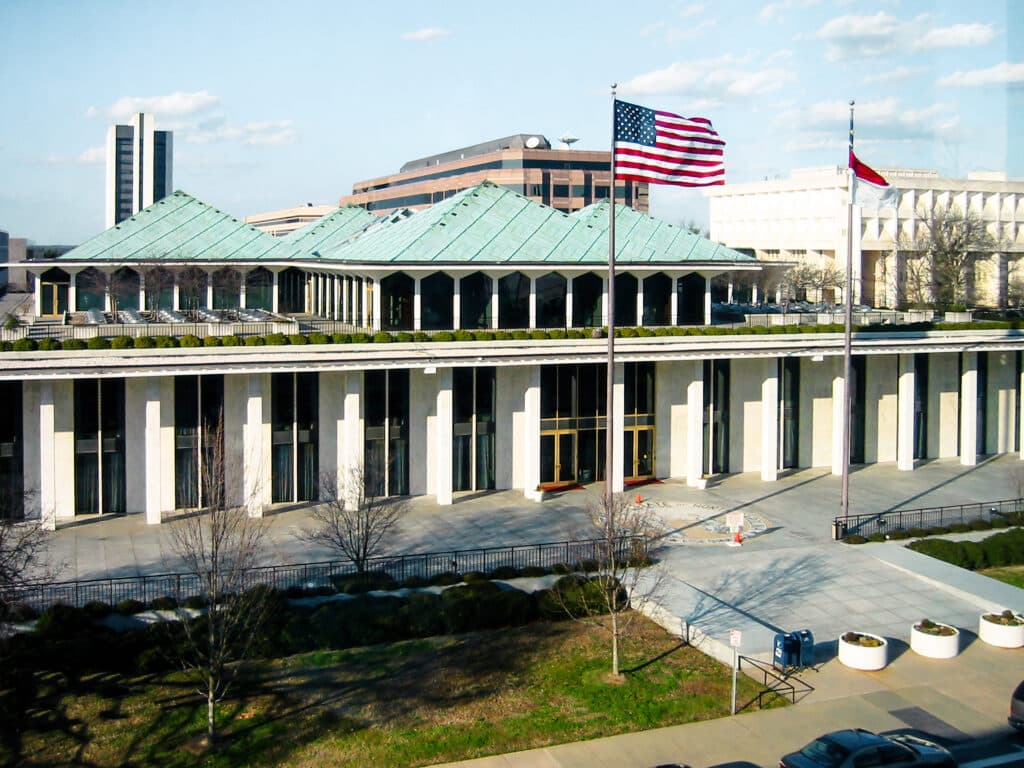
More than a year late, the NC General Assembly has adopted a $34 billion budget bill which continues tax cuts, increases the drain of funds from the public schools in favor of massive private school voucher subsidies for wealthy families, and fails to take any steps to address soaring electric bills. The budget now goes to Governor Stein’s desk.
The details of Senate Bill (SB) 257, “2026 Appropriations Act,” were unveiled to the public for the first time last Tuesday morning, and sent to floor votes in both the House and Senate without a single public hearing, under rules which allowed no amendments. Two days later the bill had received final votes of approval in both chambers. Governor Stein has 10 days from final passage (July 12) to either sign the bill, veto it, or allow it to become law without his signature.
While the bill passed with substantial bipartisan support, Rep. Amos Quick (D-Guilford) summed up many of Democratic lawmakers’ sentiments: “I will vote for this budget, but I’ll vote for it with the same enthusiasm as I have when I eat fast food for dinner — and that’s not much.”
“It’s remarkable that it took the Republican majority over a year without enacting a budget to come up with something that does nothing to cut energy costs for North Carolinians,” remarked Dan Crawford, Senior Director of Public Affairs for the NC League of Conservation Voters (NCLCV).
Bad Environmental Impacts
The budget could have a significant impact on our environment and communities. It proposes hiding important information regarding toxic chemical pollution, namely PFAS. These harmful chemicals are difficult to remove from our environment and our bodies, and pose health risks. Our state government has millions set aside for studying these toxic chemicals, but has continually failed to use them adequately.

Additionally, SB 257 takes aim at the Collaboratory at UNC-Chapel Hill, a program covering — among other things — research into PFAS. The bill would reclassify the Collaboraty’s employees as “legislative employees,” meaning that their communications with legislators could no longer be public record, and thus not available to the general public.
Good Environmental Impacts
Not everything in the budget is terrible. On natural land conservation, the news is mostly positive. A summary by Grady O’Brien of the NC Conservation Network notes that the budget includes
- About $49 million for the Agricultural Development and Farmland Preservation Trust Fund,
- $2 million for the Agricultural Cost Share Program which provides grants for water quality best management practices on agricultural land,
- $28 million in various grant programs to local governments and nonprofits for trails, and
- $3.5 million to the Nature Conservancy for acquisition of land in Pender Co. to conserve natural areas, longleaf pine forest, and open space;
- But also makes a $2 million reduction in appropriations for the Parks and Recreation Trust Fund.
The bill also authorizes First Broad River State Trail, and establishes the Brushy Mountain State Natural Area. Finally, it takes a hatchet to environmental justice and public education, by cutting two positions with the Department of Environmental Quality’s Environmental Justice Initiative, and eliminating the Office of Environmental Education and its two associated positions.